
We've finished a second J Cell!


If you follow our blog you've already heard the exciting news, a second J Cell done already!  We're really excited at how quickly the community managed to complete a second cell.  Now we're ready to tackle a new type of cell: a starburst amacrine cell (SAC).  These cells have longer and more spindly branches than J cells, but I'm confident that we'll be able to complete this type of cell as well.  There's already a SAC available to trace on the overview.  This cell was partially traced EyeWirers during our pre-launch beta testing period.  Unfortunately the growth of the cell stalled because some of the branches are thin and a bit tricky, but we're ready to try again.  Something to bear in mind, especially when tracing an SAC, is that the piece you are given to start with will almost always continue across the cube.

The reason tracing SACs is so exciting is that they connect to J cells.  We want to start mapping this type of cell so we can see if/where the branches make contact with our two existing J cells.

Speaking of which, it's worth examining the two J cells we've done so far.  
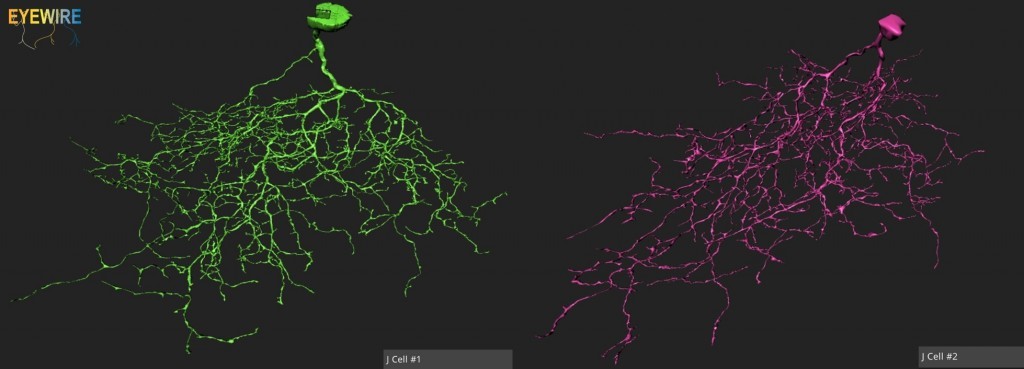


There's a definite likeness between the two, but it'd be interesting to look for differences between the two.  You can look for differences here in the side by side photos, or you can go to the EyeWire Overview and switch between the two by clicking on the blue "change the cell" button.  How similar do these cells look to you?  What are the differences?  Do you agree with us that these should be classified as the same type of cell?

Our blog post has more information and more images of the cells.  So what do you guys think?  Are these the same type of cell?  Different?  Let us know in the comments and please post screen shots so we can start the discussion.


Yay! At this rate you guys will need to throw many parties in the lab.


I’ve got two concerns about the finished J Cell #2, which raise a plethora of questions for which I’ll apologize in advance. :) Earlier I reported two possible problems.


I assume those segments that didn’t get removed didn’t turn out to be merge errors, since otherwise they would have continued growing? How do you determine whether a given branch merged incorrectly or not? Do you revise suspicious attachment points, or do you simply wait until a branch grows suspiciously big? That’s how I’ve seen it being handled so far. What would be the impact on your research if some branches did get merged incorrectly?

Regarding the ‘cut off’ branches I now actually have the opposite concern. These reminded me of these ‘lines’ you sometimes see on slices which indicate a mechanical failure during image acquisition. I was wondering whether along that ‘height’ of the cell such an error occurred, resulting in those branches to be untraceable after that point. They do seem to stop around the same height. How could such flat surfaces at the end of the branches be explained otherwise? End of the data set? What would the impact be of being unable to continue tracing those (still rather thick) branches?

Before I answer your question, I’ve a question of my own: how come the transgenic mice were not used? It seems like it would have been useful to be able to determine the location of J-cells in order to make it easier to positively identify them, as well as map their distribution. Also, it would enable the comparison of the morphology of the symmetric J-cells and the asymmetric J-cells. I do not think it would be that hard (though I may be wrong) to combine serial block face-scanning electron microscopy with a method for identifying where the J-cells are. Just pass the slices from the ultramicrotome (or the blocks? Not sure what the configuration of the EM and the ultramicrotome are, so I don’t know which would easier to do in terms of space) under a photometer with a UV filter and a UV light source to measure the amount of YFP in the slice by the amount of light produced via fluorescence, and then construct a volumetric map of the resulting data, which would enable you to locate which cubes containing the cell bodies/neurites of the J-cells.


Assuming the data from this study on J-cells are accurate, it seems a valid conclusion that these are J-cells. If junction adhesion molecules play such a large role in morphology that the presence of a specific one can distinguish cells with a unique morphology from almost all other cells (the exceptions being the J-cells that are not asymmetric), they are certainly a good way of classifying retina cells. That said, since there still are two morphologies of J-cell, I would hypothesize that the difference between the two is the presence of different other junction adhesion molecules in the two types of J-cells. If that is correct, you could classify retinal cells (or at least retinal ganglion cells) by the combinations of different junction adhesion molecules they produce, but not by any one such molecule unless it results in a single completely unique morphology.

It would be an interesting parallel avenue of study to investigate what junction adhesion molecule B binds to and what cells produce whatever that is, and then investigate their distribution within the retina.

Anyhow, I’m eager to see how the SAC turns out! I’ve been working on it for the past day and it has lots of cool looking hubs with a bunch of electrical synapses.

@whathecode


Mergers do usually continue to grow until they have been pruned.  So if something was not removed, and did not continue to grow, it is likely the piece is correct.  It is much easier to find a merger once it’s grown into an odd shape/started going in the opposite direction of everything else.  When a branch with weird behavior appears it awakens the GrimReaper.  The Reaper attempts to determine where the merger started, and then corrects the error in the cube where the trouble began.  

The weird cut off point on the branches (thanks for linking to the image) is not a natural occurrence of morphology.  The only reason you’d see something with that crisp of an edge is because that branch hit the edge of a cube.  In this case either we’ve reached the edge of our data set, or the cubes for that area haven’t been prepared yet.  

As for the impact on our research, I’ll leave that for another lab member.