Aaaand t-t-that’s all folks (luney tunes ref lol)
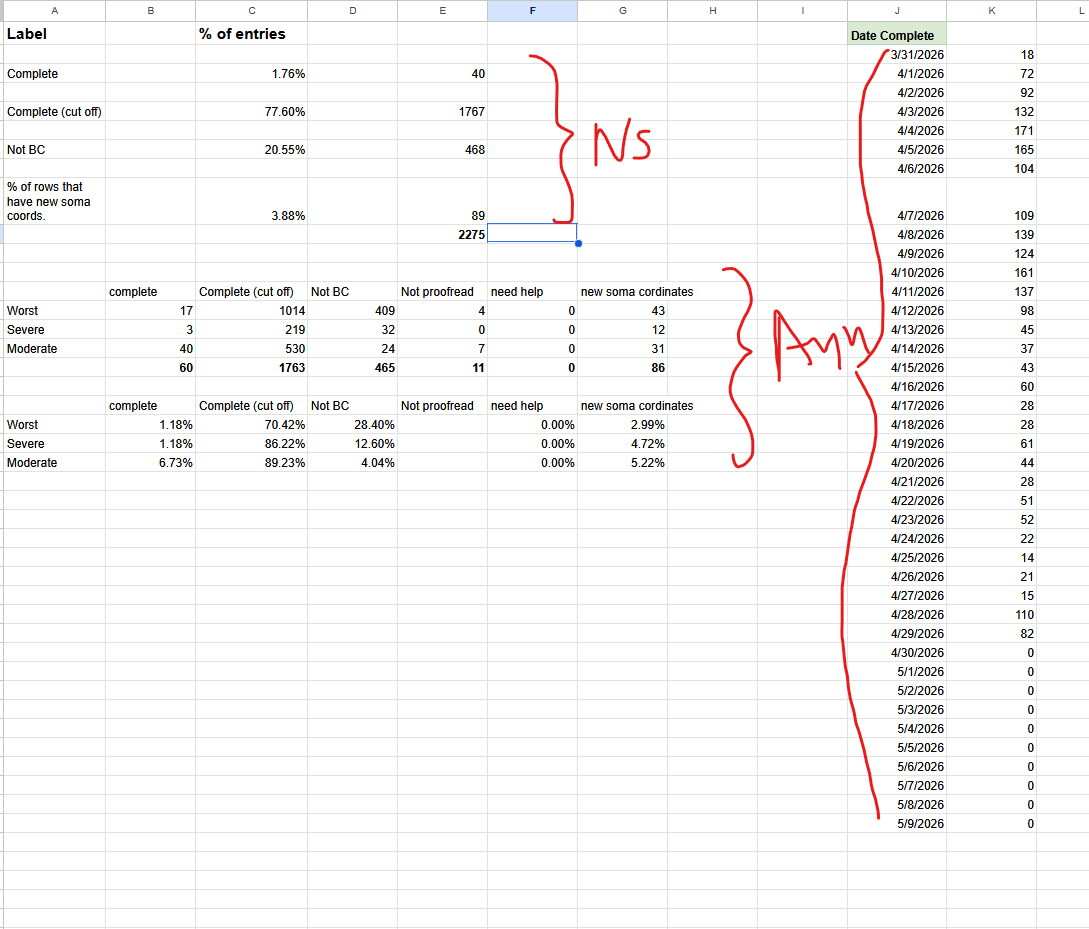
the remaining 15 or so entries missing (2290 in total) are some reserved and 2+ WIPs and such, statistically they won’t make much of a dent to the %'s.

Aaaand t-t-that’s all folks (luney tunes ref lol)
the remaining 15 or so entries missing (2290 in total) are some reserved and 2+ WIPs and such, statistically they won’t make much of a dent to the %'s.
i get impressed every time i see how much faster the proofreading is now with one month and five players compared to how long we have used in eyewire 1 on the same amount of cells. and that is without counting what the ai have already completed without human proofreading.
Well, I guess that (email) answers that, hahaha
What have you done when getting a link where the soma cordinates are in a cell that is not a BC but is merged with one or more BC cells. what i have been doing is just mark it as non BC and maybe cut it lose from the merger on the assumtion that another task will catch it.
But after rereading the instructions it is written we should move nuclous id to merger branches. even if it is made vary clear we are not supposed to work on other cells than the one with soma cordinates.
I think, the idea was to move the nucleus annotation to or close to a nucleus only, if the annotation is actually at a BP cell. If it’s somewhere else (even, if there are BPs in the merger), we should leave it as is.
Altho so far (and it is a very small sample vs 14k lol, but so far I’m not finding any non BC’s so it may end up being a moot point in this batch, but yeah I was also somewhat confused by that part of the instructions.
Not that we’ve been seeing hardly any of those cases now in the new sheet 
In the previous sheet, I just took the merged-with-BC as the ‘this is what was meant to be proofread’, under the assumption that the AI had noticed characteristics of it that were BC-like and just messed up on the soma marker placement. So for those I just moved it to the stem/soma of the actual BC after cutting off everything else
I’m going to check in about this. For now, if you could not make any edits on these cells and just write a note stating that there’s an attached BC, but not at the soma location, that would be best! I’ll update when I have more information.
Update:
We do want you to reposition the soma/stem annotation and then proofread the BC. If there’s more than one just choose one and note the other one in the notes section with segID. You can do this process going forward. Thank you!
Are there BP cells with and without axons?
Not a question so much as an FYI, but this is the 2nd RBC I’ve found where one of the boutons was barely visibly attached, and had to be extrapolated with dots. Just as a heads up to double check any of those small offshoots on RBCs!
(scuz me while I now go back and double check every RBC I did in this dataset lol)
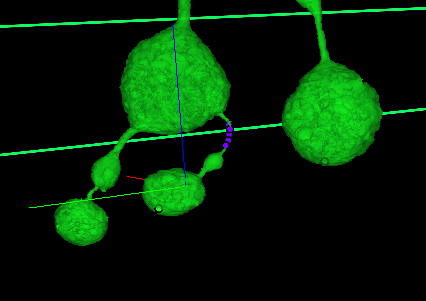
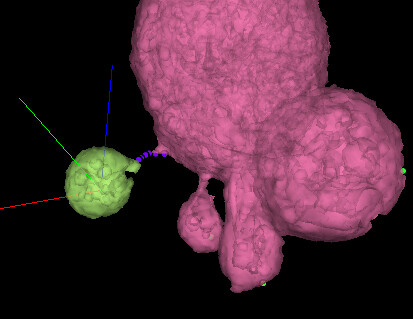
Those were Atani’s fav’s in EW lol, the uber super thin RBC (we didnt know to call them RBC back then) connections from bouton to bouton. lol
annkri also found one of these and couldn’t find a stem, and now I found one, neuroglancer
are these cells actually BP cells? And if they are what do we classify them as if we are completely unable to find a soma stem?
Line 1331 in gsheet.
My best guess is that these may be cells that are dying or not fully formed. I added a “Can’t Complete” option to the drop menu – please use sparingly for cells that have already requested a “need help” check and no additional stem can be located, and are not clearly a non-BC cell type. Please also leave a comment on these types of cells stating the issue.
You can still leave a final link with your work, but please only add one cell to the final link.
Hope that clears things up, thanks for the question!
Many thanks! And will do.
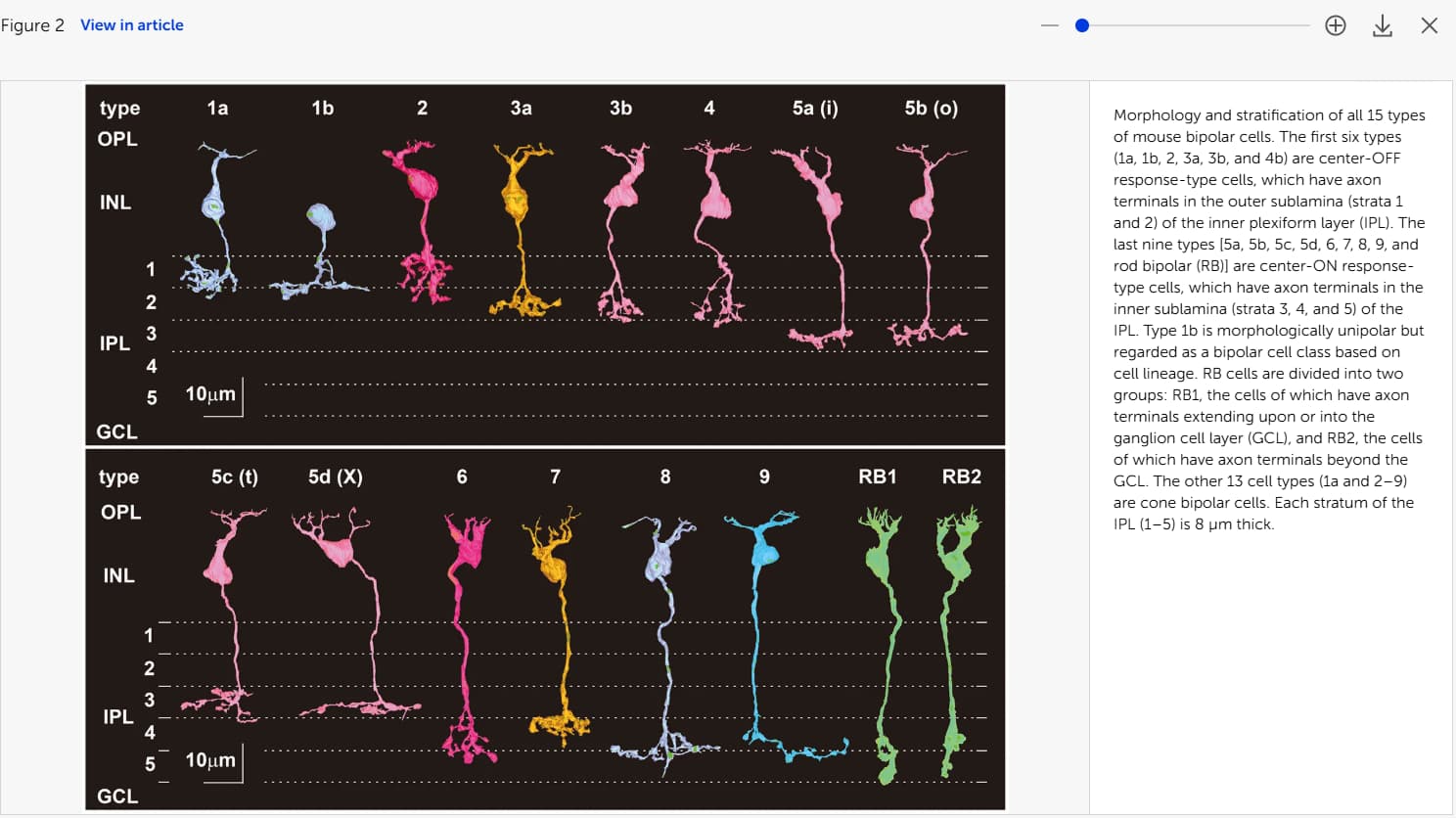
All retinal bipolar cells in vertebrates have axons. The two “poles” in bipolar refer to the dendritic arbor and the axonal arbor that emerge from either side of the cell body/soma. You can view the different types catalogued in this figure from a 2017 paper by one of the researchers currently working in the Eyewire II dataset, Yoshihiko Tsukamoto (you may find that additional figures in this paper interesting too!).
A few interesting notes:
Many thanks!
Amacrine cells don’t have axons, so it got me wondering if BPs have, or if it’s dendrites on both ends. So, I guess in EW we’ve been tracing BP axons all along, and we finally get to see some BP dendrites (and CBs ofc) in EW2.
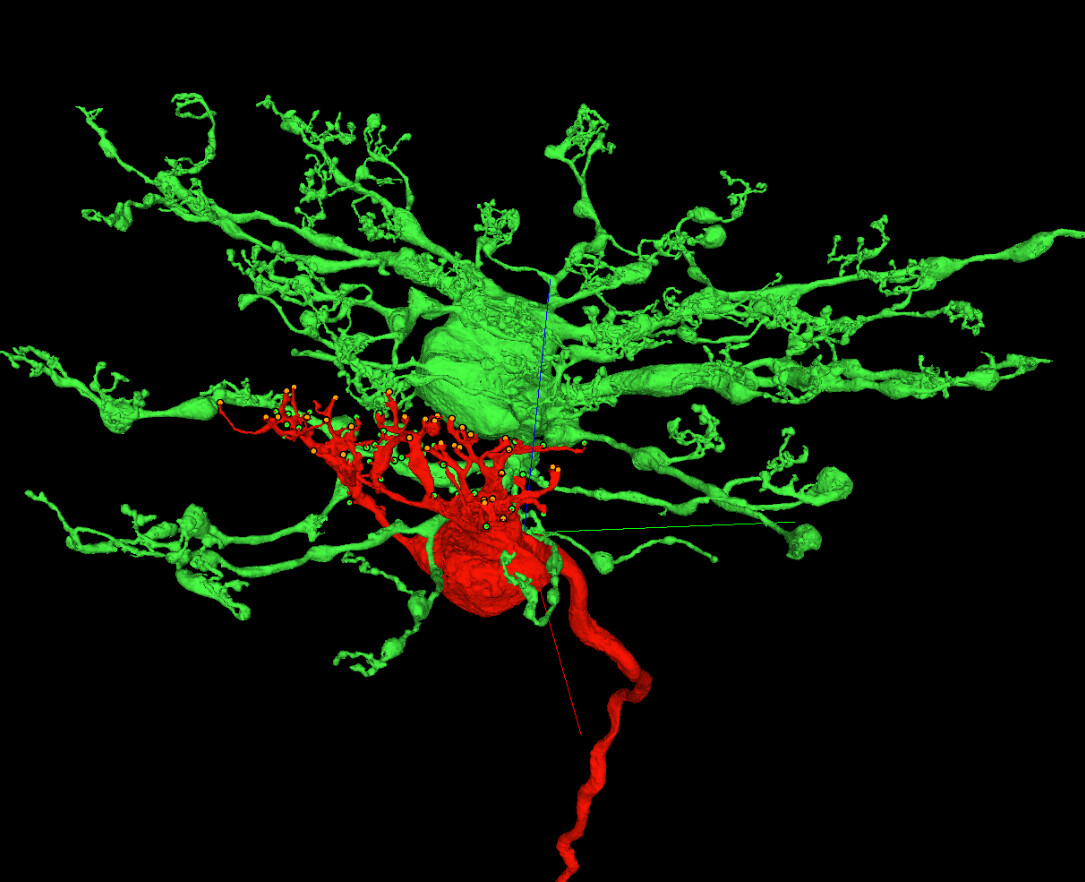
The red is a BP cell, what type is the green cell?
And is it in the near/far plans that we (citizen scientists/players) proofread those? They look mighty interesting. lol
Based on this info, are the cells AI predicts will be GluMI
https://spelunker.cave-explorer.org/#!middleauth+https://global.daf-apis.com/nglstate/api/v1/5417049932169216
(line 1400 as an example with a Soma)
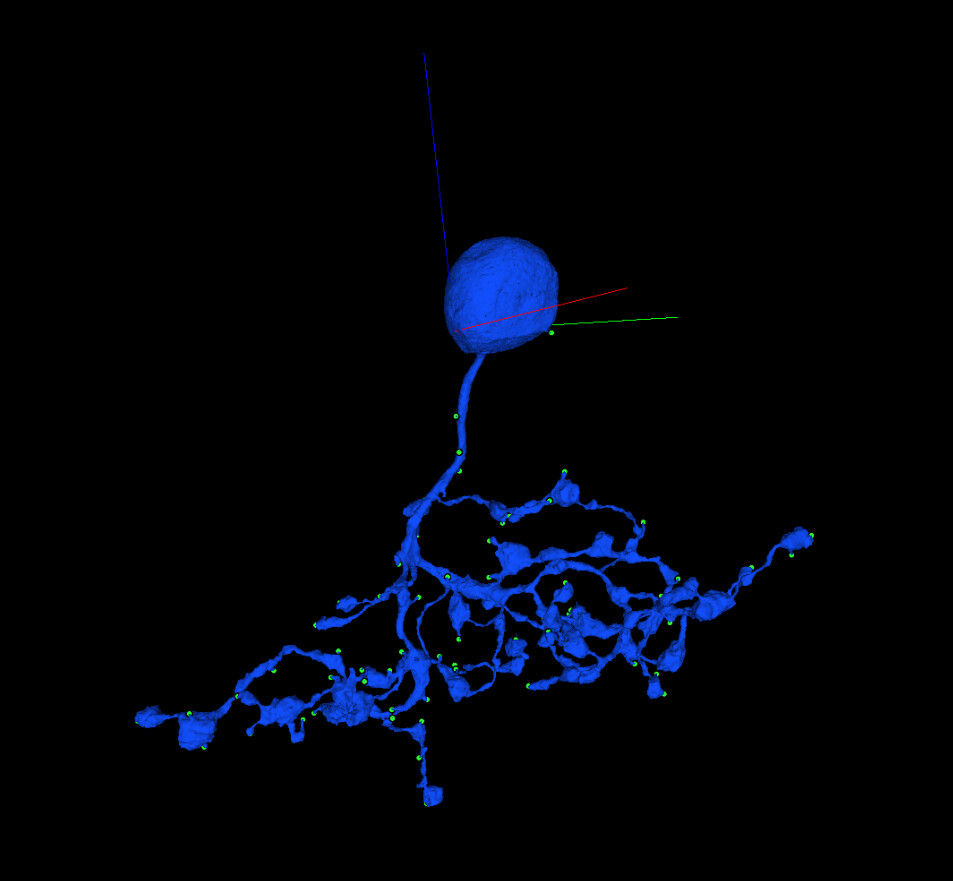
-actually- BPs? Not all have somas, but all of the ones that -do- have Somas are not like the other BPs with Somas (and dendrites). They reminds me of Amacrine cells.
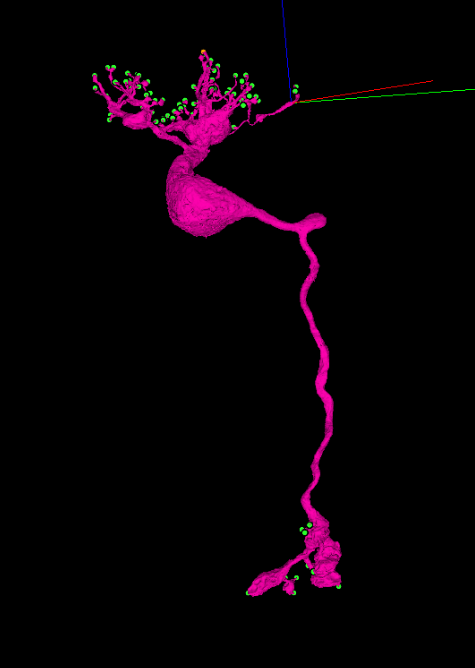
By comparison all other BP types I’ve seen with somas and dendrites are like one would expect:
Great question! You’re correct that GluMI (pronounced “gloomy”) cells aren’t technically bipolar cells and do resemble amacrine cells. However, unlike amacrine cells they act very similarly to bipolar neurons and seem to provide an alternative route of light-driven excitation to retinal ganglion cells (RGCs).
GluMI cells are a relatively “new” or novel cell type (2016 Paper). Their full name is Glutamatergic (Glu) Monopolar (M) Interneurons (I) meaning:
You may find this article from one of our members of the Eyewire II Core Team, Dr. Thomas Euler helpful in explaining these cell types. I’ll pull out some key tidbits that explain why we have the GluMIs with the bipolar cells in our spreadsheet:
like bipolar cells, this cell type features full-blown ribbons to release glutamate; unlike bipolar cells, however, the GluMi completely lacks a dendrite and thus, from a connectivity point of view, carries the features of an amacrine cell.
So how do these neurons fit into the system? For the GluMi the answer seems simple: despite lacking a dendrite and thus any direct contact with photoreceptors, they replace the bipolar cell in the dyad*.
*Note: Amacrine cells receive synaptic contacts from bipolar cells at a “dyad” where a bipolar ribbon synapse contacts two postsynaptic neurons, usually ganglion and amacrine cells.
More investigation and research needs to be studied to answer the GluMIs role and existence in this system. But clearly it’s an interesting neuron!