Eyewire II Question Box

Hi KK,

Yes, any “cosmetic” modifications are ok. As long as the annotation tabs stay the same/uniform, it is fine. Basically when they run any queuries on these links, they are pulling the annotation coordinates from the relevant layer tab name and segIDs/meshes.

Cheers,
M

2 Likes

Oh and yes, we can just ignore rows 148 and 161. Basically, we need to keep them in order to not affect the way the data is ordered/labeled.

2 Likes

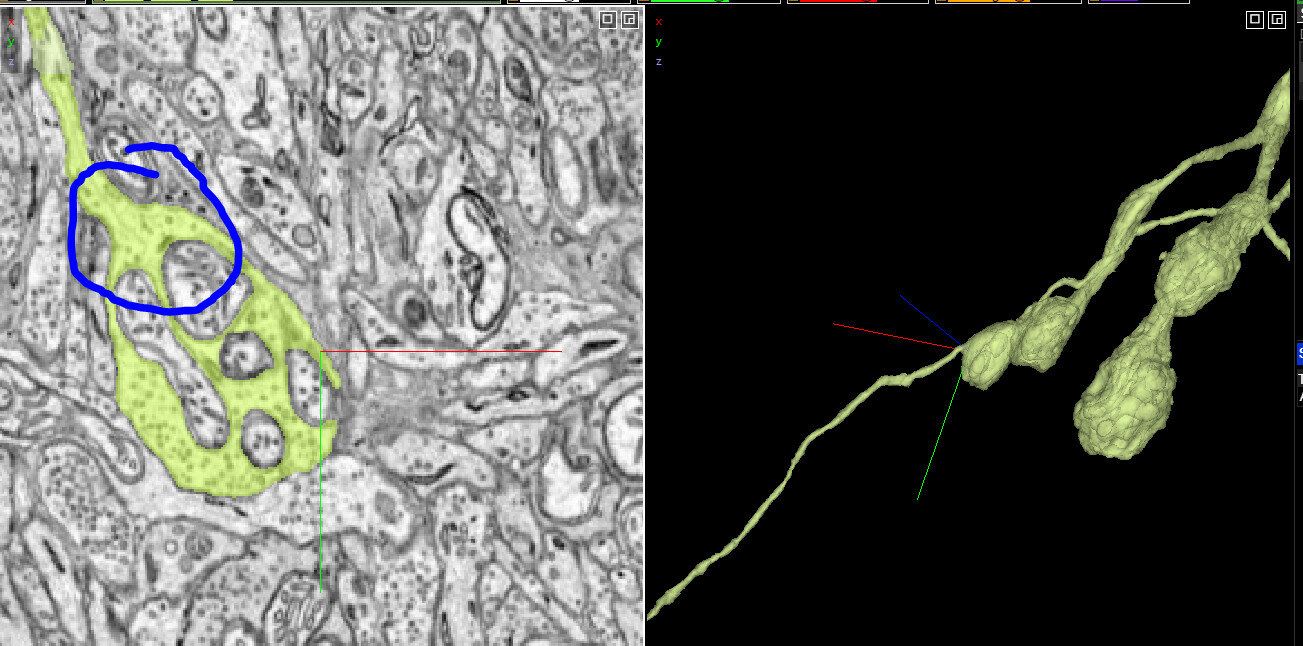
If the soma annotation is on the end of a small branch, instead of either the some itself or, at least, the main trunk, should we move the annotation?

Here’s the annotation: (also, I’m not sure, if it’s a BP cell or something else)
https://spelunker.cave-explorer.org/#!middleauth+https://global.daf-apis.com/nglstate/api/v1/6121141444804608

1 Like

Yes, this is a BP cell. As for the incorrect “soma/main trunk” annotation, can you please leave a note in the spreadsheet for this cell? I’ll also ask the researchers too.

2 Likes

I’ve found a few of with the soma coords in a bouton vs the bp stalk as well, been leaving a note with the correct coords and ‘need help’ as I can’t C&P the correct in the soma coords row/column.

2 Likes

In response to your questions about what to do if the soma annotation is in the wrong place, you can do the following:

For cells where the soma/stem coordinate is in the wrong location (not near the soma/stem, or in a merger branch) you can replace the existing coordinate with the correct one in the “Soma” tab, and add the new coordinate location to the “Corrected soma/stem coords” column.

The above instructions have also been added to the “Instructions” tab in the BC (bipolar cell) spreadsheet. Cheers!

PS. We’ve almost completed 100 cells already! That’s 5% of the ~2200 BPs :tada:

2 Likes

it’s not a question, but I didn’t know where else to post about this in the ew2 category of the forum (no other thread seemed more relatable (i’m drawing a mental blanc on the proper word right now lol)

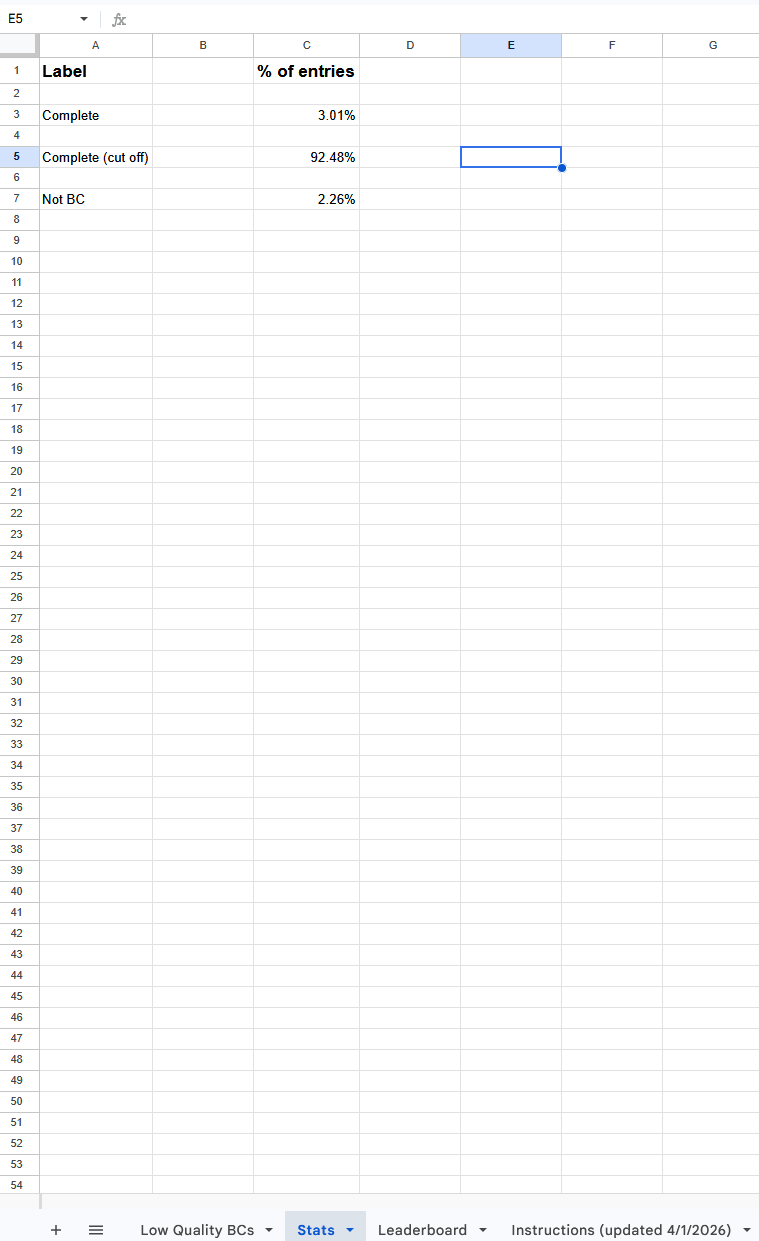
I created a diff. tab in the BCs gsheet for stats:


I added only the complete, complete (cut off) and Not BC b/c WIP and Need Help are temp. They’ll update as we complete each entry. B/c who doesn’t like statistics? lol

2 Likes

What determines the ‘quality’ of the BP cells? I’ve done moderate/worst and/or severe and as far as I can tell they’re all more or less cut off at the end of the dataset, and/or EM slides look equally…‘okay’.

1 Like

Had a task very soma cordinates is in a huge not bp cell but there is bp cell merged togheter with it. Should i mark this as not bp or move cordinates to the bp cell? neuroglancer

3 Likes

I’ve been marking those as non bp if the soma coords are not on a bp in the multi cell merger.

3 Likes

Yes, Nseraf’s response is correct. If the soma coords aren’t in a bp cell, then mark as not bp and move on to the next task. We used automated detection to find BCs (that hadn’t been manually added by a human) in the dataset, so sometimes the computer is wrong.

3 Likes

We used an automated detection system to find the bps and apply labels to the cells which included “Cell Quality”. The parameters for “Cell Quality” included asking: “Does the cell look strange? Either too large or not round enough?”.

So cells that are labeled “Severe” or “Worst” most likely have a large merger on them that’s pretty obvious and easy for us to cut off or the cell got cut off at the edge of the dataset in such a way that the system couldn’t find a good match with a bipolar cell in the ground truth.

3 Likes

Thanks, yeah makes sense, most if not all of the non bps/large multi cell mergers are on a severe/worst label.

2 Likes

do this mean there is also a bunch of good bipolar cells that will not be proofread by humans at all

2 Likes

Yes, there will be cells that will not be proofread or need any proofreading. You’ll notice that in the Eyewire II dataset that the AI has done a good job of reconstructing the cells. This is due to the high quality of the EM images, ground truth training data of cells from Eyewire (e2198) and overall improvement in the algorithms for reconstruction. We’ve come a long way since 2012 when Eyewire launched!

Since the automated reconstruction of EWII cells are quite comprehensive, it is easy to identify cell types even if they have proofreading errors in them. Researchers in the EWII community (including those that specialize in retinal bps) were able to sort and label the majority of the 40k+ bipolar cells before proofreading.

There will still be a need for human proofreading; especially as we pursue mapping more complex brains with more neurons. The automated systems will be able to scale up to make it possible for us to reasonably reconstruct larger datasets in a timely and economical manner.

3 Likes

will the algorithms be run several times on smaller parts of the dataset like all bipolar counted as bad in case the manual proffreading is splitting up mergers and thus catch more cells without need for human proofreading. I suppose there are more bp cells in need of proofreading than the tasks now on the list? i am seeing that several of the tasks already on the list have already been changed after the task was made. Or do you need to run them on the whole dataset at once?

2 Likes

I’m not surprised that some cells may have been fixed before being claimed in the spreadsheet – they could have been fixed by another task in the list or by a member of the community working in the dataset (and unaware of the spreadsheet). Such is the nature of neuroglancer…

And yes, another pass on the list of all ~40k bp cells will be run once we’re done with the current list; that way we can confirm if we’ve gotten all the cells with errors or considered “low quality”. As with any brain mapping project, the process is iterative.

And yes, if there is a particular region of interest in a dataset, an algorithm can be run to only check in those coordinates. We use(d) similar approaches in regions in the BANC/FlyWire. For this bipolar mission, we’re looking at the whole dataset.


More info on how the majority of the bipolars got found:

First, the research community manually searched for and identified bipolar cells in the entire dataset. They also took advantage of specialized synapses found in retinal bipolar cells called “ribbon synapses”. Ground truth training data for a ribbon synapse detection algorithm was created by the researchers manually finding and labeling ribbon synapses. This took quite some time and several iterations for the detection algorithm to get to an acceptable threshold of results (~90% accuracy).

Once we had a list of bps compiled from both manual searching and the ribbon synapse detection, one of our researchers was able to create some queries for sorting the cells in the list. One query was based on the “Cell Quality” parameter I mentioned above to find cells that by comparison to other bipolar cells are “too large” (too many supervoxels or too big of a skeleton mesh) or don’t have good morphology (ie. not round enough). This helps us to focus on fixing the biggest errors in proofreading or identification.

2 Likes